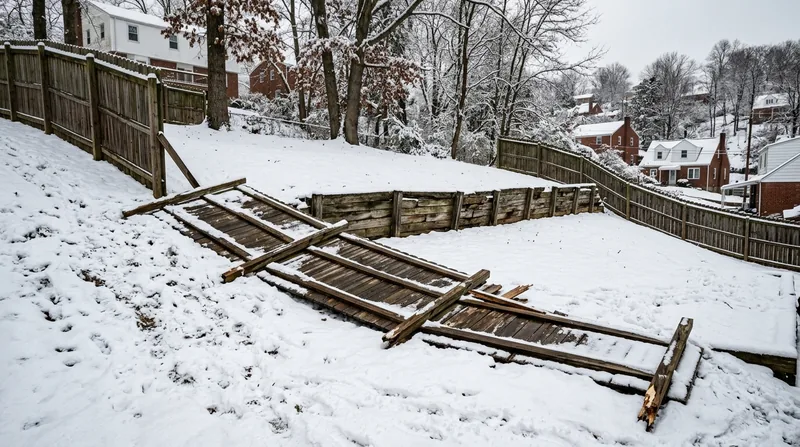




Wet snow loads bend and snap fence panels across Pittsburgh most winters, and summer thunderstorms do the same. When a storm brings down a section of your fence, the damage is often visible and urgent, but the repair itself requires more than nailing boards back together. Storm damage fence repair in Pittsburgh means assessing whether posts are set deep enough to hold through the next freeze-thaw cycle, whether the frame is salvageable, and whether the run will stand for years to come or fail again next season. Pittsburgh's dense rowhouse and twin housing stock gives way to older suburban lots where fences run short, sit right on property lines shared with neighbors, and often face alley access and narrow side yards that make replacement harder than it looks. The defining local fact is the freeze-thaw cycle: water in the ground expands each winter and lifts shallow posts season after season, so footing depth below the frost line is what separates a fence that lasts from one that does not. We assess storm damage from saturated hillside movement, bent and broken panels, and heaved posts, then rebuild the run to hold through the next cycle. Our crews work from the customer's existing property line and install posts set in concrete at proper depth.
Why Pittsburgh Winters and Wet Snow Make Fence Damage So Common
Pittsburgh's freeze-thaw cycle is relentless. Water enters the soil around fence posts every fall and spring, expands as it freezes, and heaves shallow posts upward. A fence installed with posts tamped into soil rather than set in concrete will rise and settle with every cycle, loosening rails and pickets until the whole run sags or leans. Wet snow loads in winter add tremendous weight to panels, especially board-on-board runs and privacy fences that catch wind and snow like a sail. Summer thunderstorms snap stringers and bend posts outward. By the time visible damage appears, the structural failure has often been building for seasons.
- Posts set shallow or in tamped soil heave upward each winter and never settle back to the same level.
- Wet heavy snow weighs down panels and bends or snaps stringers, especially on runs over 6 feet tall.
- Wind-driven rain and ice penetrate board-on-board joints and rot pressure-treated pine from the inside out.
- Bent or broken rails and pickets weaken the entire panel, making it fail faster in the next storm.
- Posts that lean or twist lose their hold on gate hardware and anti-sag bracing, causing gates to bind or sag.
Prompt repair prevents a small damage zone from spreading across the entire run and stops the cycle of seasonal failure.
Key info: In Pittsburgh neighborhoods like Mount Oliver, Dormont, and Baldwin, fence runs often sit on boundaries that predate modern surveys and share property lines with immediate neighbors. Before repair, confirm your property line and check whether your HOA or deed restrictions limit height, material, or color. Your neighbor may share the cost of a boundary fence, but that depends on local law and your deeds, not on the damage itself.
For more details on the full range of fence repair work we handle, see our fence repair service page.
How We Assess and Repair Storm Damage: The Pittsburgh Approach
Assessment starts on-site. We measure post spacing, check concrete footing depth by probing the soil around each post, inspect rails and stringers for cracks or bends, and look for signs of rot or moisture damage at the ground line. If posts are set shallow, heaved, or leaning, we note whether repair or replacement is the better spend. A bent stringer on a run with solid posts and good pickets is worth fixing; a fence with heaved posts and rotted lower boards usually needs a full replacement. We work from your existing survey or the line you identify and install posts set in concrete below the frost line, so the repair holds through the next freeze-thaw cycle.
- We arrive on-site and photograph the damage, noting which panels are bent, which posts are heaved or leaning, and whether the damage is isolated or spans multiple sections.
- We probe the soil around posts to determine footing depth and check whether concrete is present or posts are tamped into soil.
- We inspect rails, stringers, and pickets for cracks, splits, rot, and moisture damage, especially at the ground line.
- We assess whether the run can be repaired by replacing the damaged section or whether full replacement is the better long-term choice.
- We provide a detailed estimate that breaks down labor, materials, and any special work like utility locates or removal of old concrete.
- Once approved, we remove damaged panels and posts, call 811 for utility locates, and set new posts in concrete at proper depth.
- We install new rails and pickets to match the existing fence, or rebuild the entire run if the original is too far gone.
The entire process, from assessment to finished repair, takes one to three days depending on the length of the damaged run and site access.
Local example: A homeowner in Brentwood had a wood privacy fence with 4x4 posts set in tamped soil. Winter heave lifted the posts 2 to 3 inches, and wet snow bent the stringers. We removed the damaged section, reset the posts in concrete below the frost line, and replaced the bent stringers and damaged pickets. The repair cost less than half the price of a full replacement, and the fence is now built to last through the next ten freeze-thaw cycles.
For post-specific repair work, see our fence post repair and replacement page.
| Approach | Description | Best for |
|---|---|---|
| Repair damaged section | Remove bent or broken rails, stringers, and pickets; reset heaved posts in concrete; install new materials to match the existing fence. | Isolated damage, solid posts and frame, fence under 10 years old. |
| Replace entire run | Remove old fence and posts, call 811 for utility locates, set new posts in concrete below frost line, install new panels with proper spacing and anti-sag bracing. | Multiple heaved posts, widespread rot, fence over 15 years old, or customer prefers a fresh start. |
| Reinforce with anti-sag bracing | Add diagonal bracing or tension bands to existing stringers to prevent future bending and sagging under snow or wind load. | Tall privacy fences, runs over 6 feet, or areas with heavy snow and wind exposure. |
| Convert to stronger material | Replace wood with vinyl or chain link, which does not rot and requires no seasonal maintenance or reinforcement. | Fence in shaded or wet areas, frequent storm damage, or customer wants to eliminate annual staining and repair. |
Storm Damage Fence Repair Cost in Pittsburgh: What to Expect
The cost of storm damage fence repair depends on how much of the fence is damaged, whether posts are salvageable, and whether you repair or replace. A free damage assessment is the starting point. We arrive on-site, measure the damaged run, check post depth and condition, and provide a detailed estimate within 24 hours. Most homeowners spend between $500 and $3,000 on a storm repair, but a full-run replacement can run $5,000 to $15,000 depending on the length, material, and post depth required.
Factors that affect cost include the length of the damaged run (we charge by the linear foot), whether posts need replacement or just resetting, the material you choose (pressure-treated pine costs less than cedar or vinyl), site access (narrow side yards or alley access add labor), and whether utility locates are required (811 calls are free but add a day to the timeline). Getting two or three estimates from different contractors helps you understand the range and spot any outliers. Our pricing page gives ballpark figures for common repairs and replacements.
Insurance may cover storm damage if your homeowners policy includes fence coverage and the damage is sudden and accidental, not from lack of maintenance. We can help document the damage for your claim, but the final decision rests with your insurer. Call us at (412) 754-7811 to schedule a free assessment and get a written estimate you can submit to your insurance company.
Storm Damage Fence Repair Near Me: What Pittsburgh Homeowners Should Know Before Hiring
When choosing a fence contractor for storm repair, verify that the company is fully insured with general liability and workers' compensation coverage, and ask for a certificate of insurance on request. Pennsylvania has no state license for fence installation, so you will not see a license number on a contractor's truck or website. Instead, ask whether the contractor is registered with the Pennsylvania Office of Attorney General under HICPA (Home Improvement Contractor Performance Act) if the job will exceed $5,000; that registration is required by law for any home improvement over that threshold. Check references from recent storm repairs in your neighborhood, get multiple estimates in writing, and make sure the contractor has done work in your specific city or municipality, because setback, height, and material rules vary across Greater Pittsburgh. Some neighborhoods have HOA restrictions or deed covenants that limit fence height or color, so confirm those before you sign a contract. If your fence runs along a property line shared with a neighbor, check your deed and local law to see whether your neighbor shares the cost of repair or replacement; that depends on the law where you live, not on the damage itself.
- Ask the contractor to provide a certificate of insurance showing general liability and workers' compensation coverage before work begins.
- Request references from at least two recent storm repair jobs in Pittsburgh or your specific municipality.
- Get written estimates from at least two contractors and compare the scope, materials, and timeline.
- Confirm that the contractor will call 811 for utility locates before digging post holes, as required by Pennsylvania law.
- Check your deed and your city or township zoning rules for fence height, setback, and material restrictions before approving the repair.
- If your fence is on a shared property line, consult your deed or local law to determine whether a neighbor shares the repair cost.
We are fully insured and have been in business since 2012, serving Pittsburgh and surrounding areas including Mount Oliver, Dormont, Baldwin, Green Tree, Brentwood, Wilkinsburg, Castle Shannon, Whitehall, Carnegie, West Mifflin, Bethel Park, Bridgeville, McKeesport, Monroeville, Plum, Sewickley, Canonsburg, Murrysville, and Irwin. Our crews handle the work directly, not through subcontractors, and we stand behind every repair with a written warranty. Call us at (412) 754-7811 or visit our contact page to schedule a free damage assessment and get a detailed estimate.
Storm Damage Fence Repair in Pittsburgh: Pricing Guide
| Service | Price | Details |
|---|---|---|
| Free damage assessment | Free | On-site inspection, photos, post depth check, and written estimate within 24 hours, no obligation to book |
| Storm repair, short run (up to 50 linear feet) | Starting at $800 | Remove damaged panels and posts, reset or replace posts in concrete, install new rails and pickets to match existing fence |
| Storm repair, medium run (50 to 150 linear feet) | Starting at $2,200 | Full section removal, utility locate, new posts set below frost line, new frame and pickets, labor and materials included |
| Full run replacement or complex damage | On estimate | Entire fence removal, new posts, frame, and panels; material choice (wood, vinyl, chain link) and site access determine final price |
| Travel | Included | No separate call-out or mileage fee within Pittsburgh and surrounding service areas |
| Estimate | Free | Response within 24 hours at (412) 754-7811, written scope and pricing, no pressure to commit |
Indicative pricing, the exact cost depends on square footage, finish, and site access. Free personalized estimate within 24h at (412) 754-7811.


