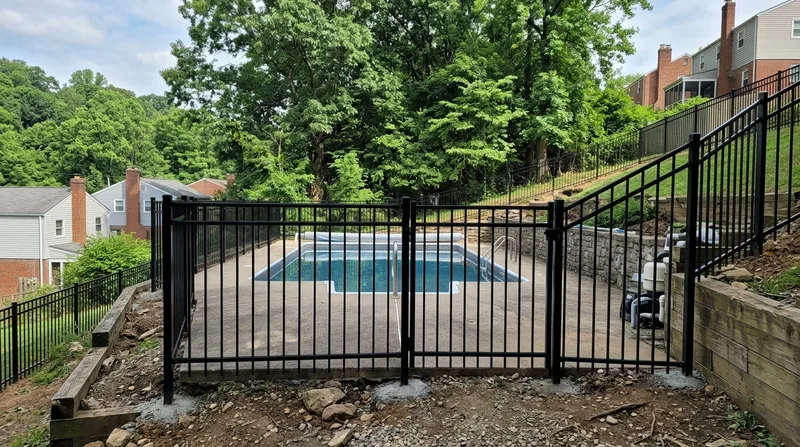




Pool fence installation in Pittsburgh requires more than standard fencing knowledge. The freeze-thaw cycle that defines our winters heaves shallow posts season after season, making footing depth below the frost line the difference between a barrier that holds and one that fails within a year or two. Dense rowhouse neighborhoods with narrow side yards and shared boundaries make pool fencing a tight engineering problem, and Pennsylvania state law sets specific pool barrier codes that your local building department enforces. A pool fence must keep young children out, hang a self-closing pool gate that swings away from the water, and meet the height and gap specifications your jurisdiction requires. We set posts correctly from the start, size the gaps to code, and hang gates to latch high and swing away every time, so your barrier works year after year.
Why Pool Barrier Codes Matter in Pittsburgh and the Greater Area
Pennsylvania sets pool barrier requirements in state code, and your local building department interprets and enforces them at your address. A pool safety fence is not optional if you have a pool. The code specifies gate height, gap size between pickets or mesh, latch mechanism height, and whether the gate must be self-closing and self-latching. A gate that swings toward the water or a gap wide enough for a child's head to pass through turns a barrier into a liability. Winter heave in Pittsburgh makes post settling a chronic problem for shallow footings, so we set posts below the frost line in concrete, which keeps them from lifting season after season.
- Contact your local building department or the Pennsylvania Department of Environmental Protection to confirm the exact pool barrier code that applies to your address and pool type.
- Posts must be set deep enough to stay below the frost line, or winter expansion will lift them and compromise the barrier height and gate operation.
- Gate latches must be mounted high (typically 54 inches or higher) and the gate must swing away from the water, so children cannot pull it open and reach the pool.
- Gaps between pickets, boards, or mesh must be small enough to prevent a child's head or body from passing through, typically 4 inches or less.
Getting the code requirements right before you start saves money and keeps your barrier compliant from day one.
Key info: Pool barrier codes in Pennsylvania vary by county and municipality. A fence that meets code in Pittsburgh may not meet code in Monroeville or Canonsburg. Always verify requirements with your local building department before design or installation begins.
How We Install Pool Fences in Pittsburgh: The Frost Line and Beyond
A pool fence in Pittsburgh starts with post placement. We call Pennsylvania 811 to locate utilities, then dig post holes below the frost line (typically 42 to 48 inches deep here) and set posts in concrete. The concrete collar prevents water from pooling at the base and keeps the post from heaving. We then build the fence to your chosen material and height, hang the gate with self-closing self-latching hardware, and verify that gaps meet code and the gate swings away from the water every time.
- Call Pennsylvania 811 to locate all underground utilities (required by law before any digging).
- Dig post holes below the frost line and set posts in concrete to prevent winter heave.
- Build the fence frame and infill (wood boards, vinyl panels, or mesh) to match your code and height requirement.
- Hang the gate with self-closing and self-latching hardware mounted at code height.
- Verify all gaps, gate swing direction, and latch operation before we leave the site.
This sequence ensures your barrier is built to last through Pittsburgh winters and meets code from the start.
Local example: A Baldwin homeowner with a 30-foot pool perimeter chose a removable vinyl mesh fence to simplify seasonal storage. We set four corner posts and two gate posts below the frost line, hung the mesh panels on aluminum frames, and mounted a self-latching gate that swings away from the water. The job took three days and cost approximately $2,400 installed. The mesh design lets sunlight and sight lines through while meeting code gap requirements.
For aluminum pool fence and other material options, see our aluminum and ornamental iron fencing page. For gate hardware and operation details, visit our gate installation and repair service.
Pool Fence Installation Methods and Materials
| Method or Material | Description | Best For |
|---|---|---|
| Wood or pressure-treated boards | Solid fence with pickets or boards set side-by-side or board-on-board, posts set in concrete below frost line. | Maximum privacy and wind blocking; traditional Pittsburgh aesthetic; requires staining or sealing every 2-3 years. |
| Vinyl or PVC panels | Solid vinyl panels hung on aluminum or vinyl frames, no painting or staining needed, posts set in concrete. | Low maintenance; durable in freeze-thaw cycles; higher upfront cost but no annual sealing. |
| Removable mesh pool fence | Lightweight vinyl mesh panels on aluminum frames that remove and store seasonally, posts set in concrete for permanence. | Seasonal use; allows sight lines and airflow; meets code gap requirements; easy to take down and store in winter. |
| Aluminum or ornamental iron | Metal posts and rails with pickets or balusters, typically powder-coated for corrosion resistance, posts set in concrete. | High durability and low maintenance; elegant appearance; excellent for code compliance; handles Pittsburgh winters well. |
Each method meets code when posts are set below the frost line and gaps are sized correctly. Choice depends on your maintenance tolerance, aesthetic preference, and budget.
Pool Fence Installation Cost in Pittsburgh: What to Expect
Pool fence installation in Pittsburgh starts at approximately $38 per linear foot for a basic removable mesh fence with posts set below the frost line and a self-latching gate included. Wood fences run higher because lumber and staining cost more. Vinyl and aluminum fences cost more upfront but require no annual sealing. Gate complexity, corner posts, terrain access, and whether your lot requires stepped or racked installation (common on Pittsburgh's sloped lots) all move the price up. A 30-foot perimeter with a single gate typically ranges from $1,800 to $3,500 depending on material and site conditions. Getting two or three estimates from local contractors helps you understand what your site costs and what each material choice adds to the job.
See our full pricing overview for detailed rates by material and scope. Factors that affect cost include post depth below the frost line (non-negotiable in Pittsburgh), gate hardware and latch mechanism, material choice and finish, and site access for equipment and crews. Call us at (412) 754-7811 for a free estimate tailored to your property and code requirements.
Pool Fence Installation Near Me: What Pittsburgh Homeowners Should Know When Hiring
Hiring a pool fence contractor in Pittsburgh means checking three things: insurance, knowledge of local pool barrier codes, and understanding how fence work is regulated in Pennsylvania. Pennsylvania has no state contractor license for fence work. Work valued at $5,000 or more per year in home improvements requires registration with the Pennsylvania Office of Attorney General under HICPA, but that registration is not a license and does not guarantee competence. What matters is that your contractor understands Pittsburgh's freeze-thaw cycle, knows how to set posts below the frost line, and can read the pool barrier code that applies to your address. Get multiple estimates, ask for references from pool fence jobs completed in the last two years, and verify that the contractor carries general liability and workers' compensation insurance. Ask to see a certificate of insurance before work begins.
- Check that your contractor carries general liability and workers' compensation insurance and can provide a certificate on request.
- Confirm that the contractor has installed pool fences in Pittsburgh and understands the frost line depth and local code requirements.
- Ask for at least two references from homeowners with completed pool fence installations in the Pittsburgh area.
- Verify that your homeowner's association (if you have one) approves the fence material, height, and color before installation begins.
- Confirm with your local building department whether a permit is required and whether a final inspection is needed before you use the pool.
A contractor who sets posts below the frost line, sizes gaps to code, and hangs the gate to latch high and swing away is your best protection against costly repairs and code violations.
Contact us at Pittsburgh Fence Company for a free estimate and a conversation about your pool barrier requirements. We have been installing and repairing fences across Pittsburgh and the surrounding area since 2012, and we are members of the American Fence Association.
Pool Fence Installation in Pittsburgh: Pricing Guide
| Service | Price | Details |
|---|---|---|
| Removable mesh pool fence | Starting at $38/ft | Vinyl mesh panels on aluminum frames with posts set below frost line and self-latching gate included |
| Wood or pressure-treated board fence | Starting at $45/ft | Solid boards side-by-side or board-on-board, posts in concrete, includes initial stain or sealing application |
| Vinyl or PVC panel fence | Starting at $52/ft | Solid vinyl panels on aluminum frames, posts set in concrete, no annual maintenance required after installation |
| Aluminum or ornamental iron fence | Starting at $60/ft | Metal posts and rails with powder-coated finish, posts set in concrete, durable in freeze-thaw cycles |
| Gate installation with self-closing latch hardware | Starting at $400 | Includes frame, hinges, self-closing and self-latching mechanism mounted at code height, tested for operation |
| Free estimate | No charge | Response within 24 hours at (412) 754-7811, site inspection, code review, and written proposal included |
Indicative pricing, the exact cost depends on square footage, finish, and site access. Free personalized estimate within 24h at (412) 754-7811.


