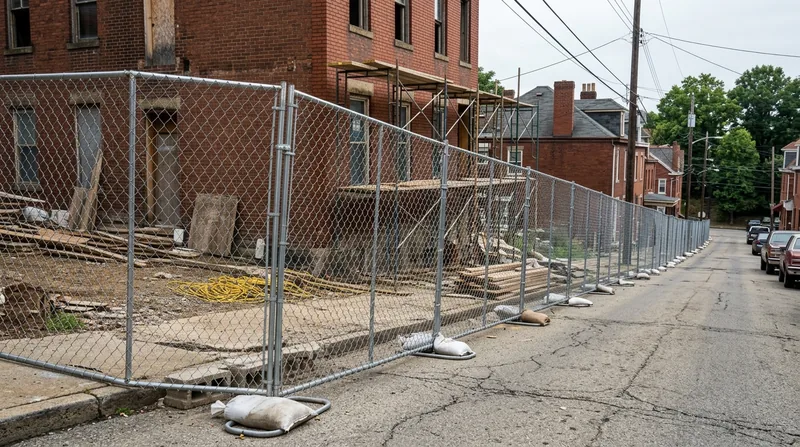




Construction sites, retail developments, and utility work across Pittsburgh and surrounding Allegheny County need commercial fence installation that works on steep, uneven ground and keeps schedules tight. We set temporary panels and commercial runs on job sites where standard residential installation does not fit the timeline or terrain. From Mount Oliver to Brentwood, from dense urban lots with alley access to sprawling industrial properties, we work with the practical constraints that define Greater Pittsburgh: narrow side yards, existing masonry walls, and the freeze-thaw cycle that lifts shallow posts every winter. Temporary fencing comes down on schedule. Commercial runs stay put through seasons of weather and use. Both demand posts set deep in concrete, below the frost line, so the fence does not heave or rack as the ground expands and contracts.
Why Commercial and Temporary Fencing Matters on Pittsburgh Job Sites
A construction site without proper perimeter fencing invites liability, theft, and regulatory violations. Temporary fencing holds materials secure, keeps unauthorized foot traffic off the work area, and signals to neighbors and city inspectors that the site is controlled and professional. Commercial runs do the same for retail, warehouse, and industrial properties where security and durability over years, not weeks, are the standard. In Pittsburgh, where many job sites sit on sloped terrain or share boundaries with rowhouses and tight residential lots, standard chain link or temporary panels must adapt to the ground and respect setback rules set by the city or county.
- Temporary fencing protects materials and equipment from weather and theft during active construction.
- Commercial security fencing deters unauthorized entry and creates a clear boundary on retail, warehouse, and industrial properties.
- Temporary construction fence is removed on schedule, leaving no trace or liability on the site.
- Posts set below the frost line prevent heaving in Pittsburgh winters and keep panels plumb through freeze-thaw cycles.
- Silt fence installation on sloped lots captures sediment runoff and meets stormwater regulations during site prep and demolition.
The right temporary or commercial fence tells contractors, regulators, and neighbors that your site is secure and professionally managed.
Key info: Pittsburgh and most surrounding municipalities require a permit for temporary construction fencing on commercial properties. Check with your local building department early in the planning phase. Most temporary installations must show proper setbacks from the public right-of-way and cannot obstruct corner visibility at intersections.
For more on how we approach fencing challenges across the region, see our full service areas and the neighborhoods we cover.
How We Install Commercial and Temporary Fencing on Pittsburgh Terrain
Every job site is different. Steep hillsides demand stepped or racked installation, where panels follow the slope rather than fight it. Tight urban lots mean working around existing structures, utility lines, and shared property lines. We begin with a site visit to map the terrain, identify underground utilities via Pennsylvania 811 locate service, and confirm setback and height rules with the local building department or HOA. Then we set posts in concrete to frost-line depth, typically 36 to 42 inches in Allegheny County, so the fence stays plumb through winter.
- We locate all underground utilities using Pennsylvania 811 before digging any post holes.
- Posts are set in concrete to frost-line depth so temporary and commercial runs do not heave or rack in winter.
- Temporary panels are installed level or stepped to match sloped terrain without creating trip hazards or unstable sections.
- Commercial chain link runs are tensioned with stretcher bars and anti-sag bracing to hold plumb under wind and impact.
- Silt fence is installed along slope contours to capture runoff and meet stormwater best-management-practice rules on active sites.
- We confirm all setback, height, and material rules with your local building department or HOA before installation begins.
This methodical approach keeps your site secure, meets code, and avoids costly delays or removals.
Local example: A retail renovation in Baldwin required 240 linear feet of temporary chain link around an active construction area. The site sloped toward a residential street. We stepped the panels to follow grade, set posts in concrete 42 inches deep, and installed anti-sag bracing on the downhill runs. The fence stayed plumb through a nor'easter and was removed on the final day with no damage to the adjacent property line.
For details on our approach to other fencing challenges, including fence repair and chain link fence installation, visit our service pages.
Commercial and Temporary Fencing Methods: Choosing the Right Approach
| Approach | Description | Best for |
|---|---|---|
| Temporary chain link panels | Pre-made 6-foot panels with frame and feet, no digging required, set on level ground or in concrete sleeves for short-term jobs. | Short-term construction sites, demolition areas, events, and locations where permanent removal is planned in weeks or months. |
| Commercial chain link with posts in concrete | Posts set 36 to 42 inches deep in concrete below frost line, galvanized or powder-coated steel fabric, tension bands and stretcher bar system for durability. | Industrial properties, long-term warehouses, retail perimeters, and job sites where the fence will stand for a year or more. |
| Silt fence on sloped terrain | Geotextile fabric anchored to posts or stakes along slope contours to filter sediment runoff and meet stormwater regulations during site prep. | Hillside demolition, grading work, utility installation, and any active site where runoff must be controlled and captured. |
| Stepped or racked installation | Panels installed to follow sloped ground without creating gaps or instability, using stepped posts or racked stringers to maintain security. | Hillside lots, terraced sites, and properties where level installation is not possible and panels must adapt to grade change. |
Each method is chosen based on site terrain, job duration, local code requirements, and whether the fence stays or comes down at project end.
Commercial and Temporary Fencing Cost in Pittsburgh: What to Expect
The cost of commercial fence installation in Pittsburgh depends on the type of fencing, terrain, access, and whether posts are set in concrete or temporary panels are used. A free site quote is the starting point, because factors like slope, frost-line depth, utility conflicts, and local permit requirements change the scope and labor. Temporary chain link panels on flat ground run lower per linear foot than commercial runs set in deep concrete on hillsides. Silt fence on a sloped demolition site costs less than permanent chain link but requires proper installation to meet stormwater rules. Getting 2 or 3 estimates from local contractors is smart, so you can compare scope, materials, and timeline.
- Temporary chain link panels start lower in cost because digging and concrete are minimal or absent.
- Commercial chain link with posts in concrete costs more upfront but lasts years without maintenance or heaving.
- Sloped terrain and stepped installation add labor but prevent gaps, instability, and code violations.
- Silt fence is a cost-effective runoff control measure during active construction and demolition.
- Permit fees vary by municipality and are your responsibility, though we can help you understand what the site requires.
Visit our pricing page for ballpark figures and call (412) 754-7811 for a free estimate specific to your site and timeline.
What to Look for When Hiring a Commercial Fencing Contractor Near Pittsburgh
Hiring the right contractor for temporary or commercial fencing means checking insurance, understanding how fence work is regulated in Pennsylvania, getting multiple estimates, and verifying that the crew understands local setback and height rules. Pennsylvania has no state contractor license for fence work. However, anyone performing $5,000 or more of home improvements per year must register with the Pennsylvania Office of Attorney General under the Home Improvement Contractor Act (HICPA). Always ask your contractor for proof of current general liability and workers compensation insurance, and request a certificate of insurance before work starts. For commercial sites, confirm that your contractor has worked on similar jobs and understands the setback, height, and material rules set by your local building department and any HOA or deed restrictions. Many Pittsburgh neighborhoods and master-planned communities have architectural standards that govern fence height, material, and color, and those rules must be verified before installation.
- Ask your contractor for proof of general liability and workers compensation insurance and request a certificate of insurance on file.
- Confirm that Pennsylvania 811 utility locates will be called before any post holes are dug on your site.
- Get 2 or 3 estimates and compare scope, materials, timeline, and warranty or guarantee terms.
- Check with your local building department or HOA to confirm setback, height, and material rules before signing a contract.
- Ask for references from recent commercial or temporary fencing jobs on similar terrain or in similar neighborhoods.
- Understand what happens if weather delays the job or if the site conditions change during installation.
A contractor who takes time to understand your site, confirms the rules, and communicates clearly about cost and timeline will save you money and headaches. Call us at (412) 754-7811 or contact us online for a free estimate and a conversation about your job.
Commercial & Temporary Fencing in Pittsburgh: Pricing Guide
| Service | Price | Details |
|---|---|---|
| Temporary chain link panels | Starting at $35/panel | Pre-made 6-foot sections, minimal setup, short-term construction or event use, no digging required |
| Commercial chain link with concrete posts | $18-$28 per linear foot | Posts set 36-42 inches deep in concrete, galvanized or powder-coated steel, tension-banded, includes labor and frost-line depth |
| Silt fence installation on slopes | $8-$14 per linear foot | Geotextile fabric, posts or stakes, contoured to slope, stormwater compliance, includes layout and anchoring |
| Stepped or racked installation on hillsides | On estimate | Complex terrain requires site visit to assess grade change, post spacing, and stepped-panel configuration before pricing |
| Removal and site restoration | On estimate | Temporary fencing removal, post extraction, grade restoration, and site cleanup quoted based on linear footage and terrain |
| Free site estimate | No charge | On-site assessment, utility locate coordination, permit guidance, and detailed quote within 24 hours of contact |
Indicative pricing, the exact cost depends on square footage, finish, and site access. Free personalized estimate within 24h at (412) 754-7811.


