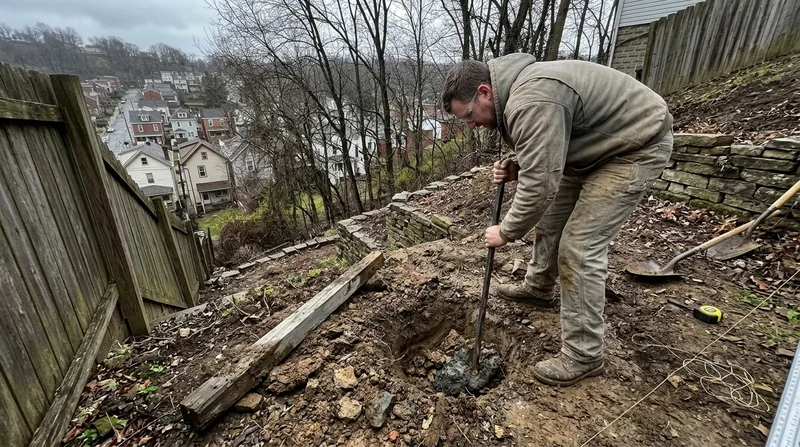




Fence posts in Pittsburgh lean, heave, and rot for one reason: water. The freeze-thaw cycle of our winters lifts shallow posts season after season, and the dense clay and colluvium soil on our hillside lots shifts downhill under load. When a post weakens, the entire fence line fails with it. Fence post repair in Pittsburgh means digging past the frost line, setting posts in concrete sized for our climate, and doing it right so the fence holds for decades. We have been doing this work since 2012, and we know exactly how deep and how solid a post needs to be on Pittsburgh ground.
Why Pittsburgh Fences Fail at the Post: Frost Heave and Soil Movement
Pittsburgh sits on terrain that moves. Hillside lots shed water downhill, colluvium soil creeps under its own weight, and every winter the freeze-thaw cycle expands water in the ground and lifts whatever is not set deep enough. A post set at 24 inches rises a quarter-inch each winter, and after ten winters it is three inches higher than where it started. The fence sags, the rails twist, and the pickets begin to gap. In rowhouse and twin neighborhoods where fence lines run tight against masonry or sit on narrow alleys, there is no room to adjust. The post must be set below the thirty-six inch frost line in concrete, not tamped soil, or it will fail.
- Posts set in tamped soil alone shift with the ground every freeze-thaw cycle and weaken the rails and pickets above them.
- Concrete-set posts anchor below the frost line and resist the heave that moves shallow posts upward each winter.
- Colluvium soil on hillsides adds downhill pressure, so posts on slopes need deeper footings and sometimes anti-sag bracing to hold the fence plumb.
- Water pooling at the base of a post rots the wood grain even when the post is set correctly, so drainage and post material matter as much as depth.
Getting the footing right the first time is the difference between a fence that lasts twenty years and one that fails in five.
Key info: Pittsburgh's frost line sits at thirty-six inches. Posts set shallower than that will heave every winter. We dig below that line and set posts in concrete sized to the post diameter and the slope of the ground. On steep lots in Dormont, Baldwin, or Green Tree, we sometimes use deeper footings and anti-sag bracing to hold the fence plumb against downhill soil movement.
For more on how to identify fence posts that are failing, see our fence repair page.
How We Repair and Replace Fence Posts in Pittsburgh: A Step-by-Step Approach
When a post is leaning, cracked, or soft at the base, we start with a site visit to decide whether repair or replacement makes sense. A post with rot only at the ground line and solid wood above can sometimes be repaired by cutting out the rot and setting a new concrete collar around the base. A post that is cracked through, heaved out of plumb by more than half an inch, or rotted deep into the grain gets replaced. We dig out the old post, remove the concrete footing if it is shallow or compromised, and set a new pressure-treated or cedar post below the frost line in concrete.
- We call 811 for a utility locate before we dig any hole, because water and electric lines run under many Pittsburgh alleys and side yards.
- We remove the old post and footing, sometimes cutting the rails back to expose the post socket so we can work without removing the entire fence.
- We dig the new hole below the thirty-six inch frost line, or deeper if the ground is unstable or the lot is steep.
- We set the new post plumb and brace it, then pour concrete around it sized to the post diameter and the load it will carry.
- We cut and fit new rails or splice the old rails into the new post, matching the original fence line and spacing.
The whole job usually takes one day for a single post, or two to three days if multiple posts are failing and the fence is long.
Local example: A homeowner in Wilkinsburg had a six-foot wood privacy fence with a leaning post that was pushing the gate off plumb. The post was set in tamped soil at twenty-four inches, and the concrete footing below it was broken. We dug out the old post and footing, set a new 6x6 pressure-treated post at forty-two inches deep in concrete, and spliced the existing rails back into the new post. The fence is now plumb and the gate swings freely.
See our fence replacement and removal page for details on when a full fence replacement makes more sense than post-by-post repair.
Fence Post Repair Methods: When to Repair, When to Replace
| Approach | Description | Best for |
|---|---|---|
| Concrete collar repair | Cut out soft wood at the base, install a concrete collar around the post to below the frost line, and seal the top to shed water. | Posts with rot only at the ground line and solid wood above; extends post life by ten to fifteen years. |
| Post replacement without fence removal | Cut the rails back, remove the old post and footing, dig below the frost line, set a new post in concrete, and splice the rails back into the new post. | Posts that are cracked, severely heaved, or rotted deep into the grain; preserves the existing fence line and pickets. |
| Anti-sag bracing | Install diagonal or cross bracing between posts to resist downhill soil pressure and prevent leaning on steep slopes. | Hillside lots where posts lean into the slope; works on wood or metal fence frames. |
| Full post and rail replacement | Remove the old post and all attached rails, set a new post below the frost line in concrete, and install new rails matched to the original fence profile. | Posts that are severely compromised or when multiple posts fail in a run; restores the fence to like-new condition. |
Each approach has a cost and a lifespan. A concrete collar repair costs less and works well when the rot is shallow, but it is a temporary fix. Post replacement costs more but solves the problem permanently and protects the rails and pickets you already have.
Fence Post Repair and Replacement Cost in Pittsburgh: What to Expect
Fence post repair and replacement in Pittsburgh starts at around $475 for a single concrete collar repair on a post that is soft at the base but structurally sound above ground. A full post replacement, including removal of the old post and footing, digging below the frost line, and setting a new post in concrete with rails spliced back, runs from $650 to $950 per post depending on the post diameter, the depth of the footing, and whether anti-sag bracing is needed. If multiple posts are failing, the cost per post sometimes comes down because we are already on site and the work is sequential.
Several factors move the price up or down. A post on a steep hillside costs more because we dig deeper and may install bracing. A post next to masonry or an alley wall costs more because access is tight and we have to work carefully to avoid damaging the neighbor's property or existing structures. A cedar post costs more than pressure-treated pine because the material is pricier. A post that is part of a chain link fence with tension bands costs more to remove and reinstall than a wood post with simple rail connections.
We always recommend getting two or three estimates from local contractors so you can compare scope, method, and price. Every site is different, and the estimate is the right place to ask questions about frost line depth, footing size, material choices, and timeline. Contact us for a free estimate at (412) 754-7811, and we will walk you through the options and the cost.
For a full breakdown of pricing across all our fence services, see our pricing page.
Hiring a Fence Contractor Near Me: What Pittsburgh Homeowners Should Know
Finding the right contractor for fence post repair in Pittsburgh means checking insurance, understanding the local permitting rules, and getting references from recent work in your neighborhood. Pennsylvania has no state license for fence installation, so you will not see a contractor license number on an estimate. What you should see is proof of general liability and workers compensation insurance, a certificate of insurance on request, and a willingness to call 811 before digging. Some cities and HOAs in the Pittsburgh area require permits for fence work, and some do not, so verify the rules for your address with your local building department or HOA before you book the job.
- Ask for references from homeowners in your area and call them to ask about the quality of the work and whether the contractor showed up on time and cleaned up afterward.
- Request a certificate of insurance showing general liability and workers compensation coverage before work starts.
- Verify whether your city or HOA requires a permit for fence work, and ask the contractor whether the estimate includes the permit cost.
- Check that the contractor calls 811 for a utility locate before digging any post hole, because water, sewer, electric, and gas lines run under Pittsburgh streets and alleys.
- Get the estimate in writing with a clear scope of work, the materials to be used, the timeline, and the total cost before you sign anything.
A good contractor will answer your questions honestly, explain why a repair or replacement makes sense, and give you a realistic timeline so you know what to expect. Call us at (412) 754-7811 to schedule a free estimate and see how we approach the work on your property.
Fence Post Repair & Replacement in Pittsburgh: Pricing Guide
| Service | Price | Details |
|---|---|---|
| Concrete collar repair | Starting at $475 | Cutting out rot at base, installing concrete collar below frost line, sealing top to shed water |
| Single post replacement | Starting at $650 | Removal of old post and footing, digging below frost line, setting new post in concrete, splicing rails back |
| Multiple posts or hillside work | Starting at $750 per post | Deeper footings, anti-sag bracing, or tight access conditions that require extra time and materials |
| Utility locate and permits | Included | 811 utility locate call and any required city or HOA fence permits are part of the estimate and scope |
| Free estimate | No cost | On-site walkthrough with timeline and cost breakdown, response within 24 hours at (412) 754-7811 |
Indicative pricing, the exact cost depends on square footage, finish, and site access. Free personalized estimate within 24h at (412) 754-7811.


